





How to Rotate Tires at Home: Step-by-Step Instructions
How to rotate tires at home comes down to five basic moves: loosen the lug nuts, lift and support the vehicle safely, move each tire to its correct new position, reinstall, and torque everything back down to spec. It’s a job many DIYers can handle with the right tools, though lifting a vehicle and removing wheels does carry real safety risks if you skip a step.
This guide walks through everything you need before you start, how to tell what rotation pattern your tires actually require, the full step-by-step process, and when it makes more sense to leave the job to a professional instead.
Key Takeaways
- Yes, you can rotate tires at home with a jack, jack stands, a lug wrench, and a torque wrench, but never rely on your vehicle’s compact emergency jack to support the car for the whole job.
- Check your tire type first. Directional tires and staggered setups (different sizes front and rear) can’t always follow a standard rotation pattern.
- The correct pattern depends on your drivetrain and tire type. There’s no single pattern that works for every vehicle.
- Torque matters as much as the rotation itself. Under- or over-tightened lug nuts can cause real safety problems.
- When in doubt, get a professional. Directional tires, staggered setups, unusual wear, or a lack of confidence with vehicle lifting are all good reasons to book a shop instead.
Can You Rotate Your Tires at Home?
For many vehicles, yes. Tire rotation is one of the more approachable DIY jobs if you have the correct equipment and understand your vehicle’s specific rotation pattern. That said, it’s not risk-free: lifting a vehicle off the ground and removing wheels means real weight is suspended above you, so proper support and careful technique matter more here than in most other DIY car maintenance.
If you’re confident with basic tools, comfortable following your owner’s manual’s lift points, and willing to double-check torque specs, this is a reasonable weekend project. If any of that gives you pause, professional tire service handles the same job with less risk.
What You Need to Rotate Your Tires
Before you start, gather the right equipment:
- A vehicle jack. A hydraulic floor jack is easier to use than the compact scissor jack that comes with most vehicles.
- Jack stands, ideally two to four depending on how many wheels you’re lifting at once. A jack alone should never support a vehicle while you’re working underneath it.
- A lug wrench or the appropriate socket sized to your vehicle’s lug nuts.
- A torque wrench, so you can tighten lug nuts to your manufacturer’s exact specification rather than guessing.
- Wheel chocks, placed against a tire that stays on the ground to keep the vehicle from rolling.
- Your owner’s manual, which lists your vehicle’s correct jack points, torque specification, and rotation pattern.
One important safety note: the compact emergency jack stored in your trunk is designed to get you through a roadside tire change, not to support your vehicle for an extended repair. Always transfer the vehicle’s weight onto proper jack stands before working underneath it. This isn’t a minor caution: the National Highway Traffic Safety Administration has issued recalls covering more than 1.7 million jack stands after reports that certain units could collapse under load, which is exactly why using solid, rated jack stands and following their weight limits matters.
Before You Start: Check Your Tire Type
Not every set of tires can follow the same rotation pattern, so confirm what you’re working with before you begin:
- Directional tires are designed to spin in only one direction, with tread patterns molded to push water outward on that specific side. They can move front to back but can’t cross from the driver’s side to the passenger’s side.
- Non-directional tires have a symmetrical tread pattern and can generally move to any position on the vehicle, which gives you more flexibility in rotation pattern.
- Staggered setups, where the front and rear tires are different sizes, often can’t be rotated in the traditional sense at all, since a rear tire may not physically fit the front axle.
- Different front/rear specifications beyond just size, such as different load ratings, can also limit which rotation patterns are safe for your vehicle.
If you’re not sure which category your tires fall into, check the tire’s sidewall for a directional arrow, or compare the size codes on your front and rear tires before assuming a standard rotation applies.
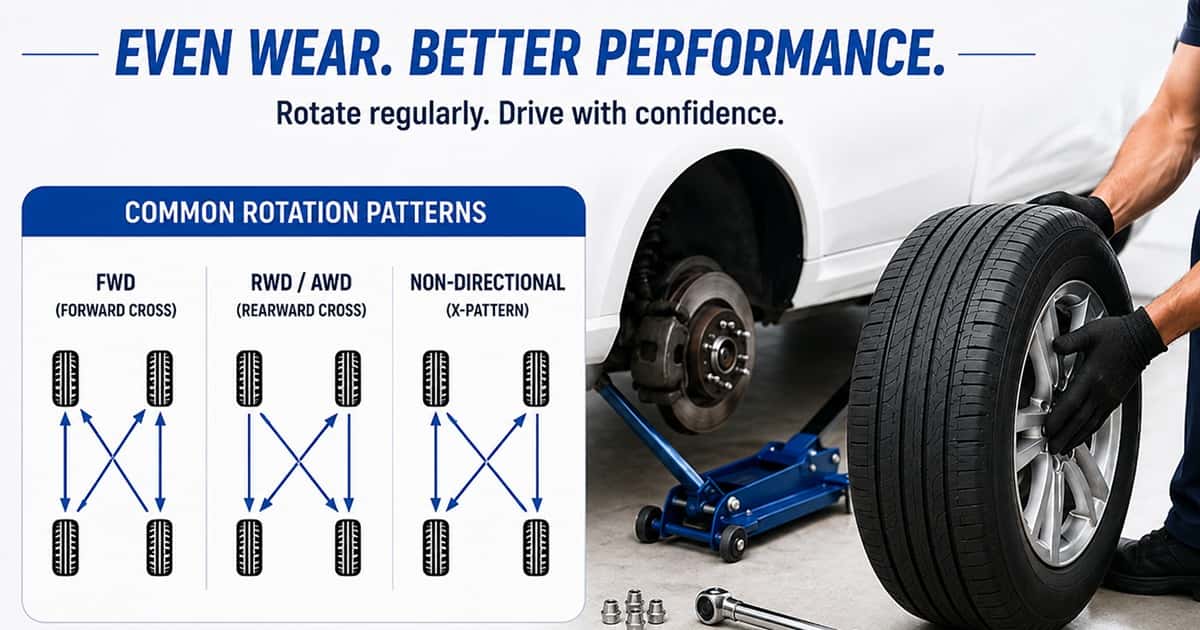
Common Tire Rotation Patterns
Once you’ve confirmed your tire type, the drivetrain determines the specific pattern:
- Forward cross, typically used on front-wheel drive vehicles: the rear tires move straight forward, while the front tires cross to the opposite side in the rear.
- Rearward cross, typically used on rear-wheel drive and some all-wheel drive vehicles: the front tires move straight back, while the rear tires cross to the opposite side up front.
- X-pattern, where all four tires cross diagonally, is sometimes used on vehicles with non-directional tires and no staggered fitment.
- Side-to-side, used only for certain setups where crossing isn’t appropriate; this pattern keeps tires on the same axle but swaps left and right.
No single pattern is correct for every vehicle. Your owner’s manual or tire manufacturer’s guidance should always take priority over a generic pattern found online.
How to Rotate Tires at Home: Step-by-Step
- Park on a level surface. A flat, stable surface, ideally concrete, gives your jack and jack stands solid footing.
- Secure the vehicle. Put the transmission in park (or first gear for a manual), engage the parking brake, and place wheel chocks against a tire that will stay on the ground.
- Loosen the lug nuts. With the vehicle still on the ground, loosen (but don’t fully remove) the lug nuts on each wheel you’ll be moving. This is much easier while the tire still has weight on it.
- Lift and support the vehicle safely. Position the jack at your vehicle’s specified lift point, raise that corner, and place a jack stand underneath before lowering the vehicle onto it. Repeat for each corner you’re working on, and never work under a vehicle supported only by a jack.
- Remove the wheels. Finish removing the lug nuts and pull each wheel off the hub.
- Follow the correct rotation pattern. Move each tire to its new position based on your vehicle’s drivetrain and tire type, as covered above.
- Reinstall the wheels. Place each wheel back on its hub and thread the lug nuts on by hand first to avoid cross-threading.
- Torque the lug nuts correctly. Once the vehicle is back on the ground, use a torque wrench to tighten each lug nut to your manufacturer’s exact specification in a star or crisscross pattern.
- Check tire pressure. With the tires now in new positions, confirm each one matches the pressure listed on your driver’s door jamb sticker, not the number on the tire’s sidewall.
- Recheck after driving if required. Some manufacturers recommend re-checking torque after a short drive, since new pressure and settling can shift the load slightly.
What Is the Correct Tire Rotation Pattern?
| Vehicle / Tire Type | Typical Rotation Pattern |
| Front-wheel drive, non-directional tires | Forward cross: rear tires move straight forward, front tires cross to the rear |
| Rear-wheel drive, non-directional tires | Rearward cross: front tires move straight back, rear tires cross to the front |
| All-wheel or four-wheel drive | Often a modified pattern accounting for power distributed across all four wheels |
| Directional tires (any drivetrain) | Front to back only, on the same side, never crossing left to right |
| Staggered setups (different front/rear sizes) | Often can’t be rotated in the traditional sense at all |
This table reflects common conventions only. Your vehicle or tire manufacturer’s specific guidance should always override a general pattern.
How Often Should You Rotate Your Tires?
Knowing how to rotate tires only solves half the maintenance question, the other half is timing. Most manufacturers recommend rotating every 5,000 to 7,500 miles, though the right interval depends on your drivetrain, tire type, and driving habits, with all-wheel and four-wheel drive vehicles often needing rotation sooner than that. Your owner’s manual has the specific interval built for your vehicle, and it should be your primary reference over any general rule of thumb. For the full breakdown of how mileage, drivetrain, and driving habits interact, see our complete guide to tire rotation frequency.
When Should You Let a Professional Rotate Your Tires?
DIY tire rotation isn’t the right call for every situation. Consider professional service if:
- You don’t have safe lifting equipment, including rated jack stands, not just the compact emergency jack.
- Your tires are directional or in a staggered setup, where the correct pattern is more complicated or the rotation isn’t possible at all.
- You notice unusual or uneven wear that suggests an alignment or suspension issue beyond simple rotation. Uneven tire wear can sometimes point to alignment issues; learn more about wheel alignment and what it costs.
- Lug nuts or studs are damaged, stripped, or difficult to remove safely.
- You’re seeing tire pressure issues that don’t resolve after a normal check and refill.
- You suspect an alignment concern, such as the vehicle pulling to one side.
- You notice vibration that wasn’t present before, which can point to a balance or alignment issue rather than something rotation alone will fix.
- You’re not confident lifting and supporting the vehicle, which is reason enough on its own to have a shop handle it.
According to Edmunds’ guide on tire rotation (2024), tire rotation is something even inexperienced at-home mechanics can typically handle, but that assumes the right tools and a clear understanding of your specific vehicle’s pattern, which is exactly where professional service adds the most value if either is missing.
Tire Rotation Service in LaGrange, GA
If you’d rather leave the lifting, torquing, and pattern-matching to a professional, Auto Gallery Chevrolet GMC’s certified service center rotates tires using the manufacturer-specified pattern and torque for your exact vehicle, not a generic guess.
That precision matters most on GMC and Chevrolet trucks and SUVs, where tire size, drivetrain, and load ratings can all affect the correct pattern. Our technicians also check tire pressure and overall condition during the visit, so you leave with a clear picture of what your tires need next.
Schedule tire rotation service with Auto Gallery Chevrolet GMC today, browse our new tire options if your current set needs replacing, or ask about tire replacement services in LaGrange.
Frequently Asked Questions
How do you rotate tires at home?
Loosen the lug nuts while the vehicle is still on the ground, lift and support it safely on jack stands, remove the wheels, move each tire to its correct new position based on your drivetrain and tire type, reinstall, and torque the lug nuts to your manufacturer’s specification.
What is the correct tire rotation pattern?
The correct pattern depends on your drivetrain and tire type. Front-wheel drive vehicles typically use a forward cross pattern, rear-wheel drive vehicles typically use a rearward cross, and directional or staggered tires often can’t follow either pattern. Your owner’s manual has the specific pattern for your vehicle.
Can you rotate tires yourself?
Yes, for many vehicles, tire rotation is a manageable DIY job with a jack, rated jack stands, a lug wrench, and a torque wrench. It’s not a good fit if you’re missing proper lifting equipment, have directional or staggered tires you’re unsure about, or aren’t confident supporting a vehicle safely.
How often should you rotate your tires?
Most manufacturers recommend every 5,000 to 7,500 miles, though all-wheel and four-wheel drive vehicles often need rotation more frequently. Your owner’s manual has the exact interval for your vehicle.
What tools do you need to rotate tires?
You’ll need a vehicle jack, rated jack stands, a lug wrench or appropriate socket, a torque wrench, wheel chocks, and your owner’s manual for the correct lift points and torque specification.
Can you rotate directional tires?
Only front to back on the same side. Directional tires are designed to spin in one direction and can’t be crossed from the driver’s side to the passenger’s side without reducing performance and water-shedding ability.

0 comment(s) so far on How to Rotate Tires at Home: Step-by-Step Instructions