





How Much Does a Wheel Alignment Cost? Pricing for LaGrange Drivers
A wheel alignment corrects your vehicle’s suspension angles so your tires meet the road correctly, and it’s one of the most overlooked (yet inexpensive) forms of car maintenance. If you’re asking how much that service actually costs, here’s the short answer: most drivers pay between $50 and $250, depending on whether you need a two-wheel or four-wheel alignment, your vehicle type, and where you have the work done.
That’s the number. But the number alone won’t tell you whether you actually need an alignment right now, why prices swing so widely between shops, or what happens if you keep putting it off. This guide breaks down the full funnel: the price, the reasons behind it, the warning signs, the risk of waiting, and where to get it done right the first time.
Key Takeaways
- National average cost: A front-end (2-wheel) alignment runs $50–$100; a full 4-wheel alignment runs $100–$250, depending on vehicle and shop.
- Price drivers: Vehicle type, suspension complexity, how far out of spec the wheels are, and local labor rates all affect your final bill.
- Warning signs: A car that pulls to one side, a crooked steering wheel, uneven tire wear, or vibration at highway speed all point to misalignment.
- Recommended frequency: Most manufacturers recommend an alignment check every 2–3 years or 12,000 miles, or any time you hit a curb, pothole, or install new tires.
- The real cost of waiting: Skipping an alignment doesn’t save money. It accelerates tire wear, which typically costs far more than the alignment itself.
How Much Does a Wheel Alignment Cost?
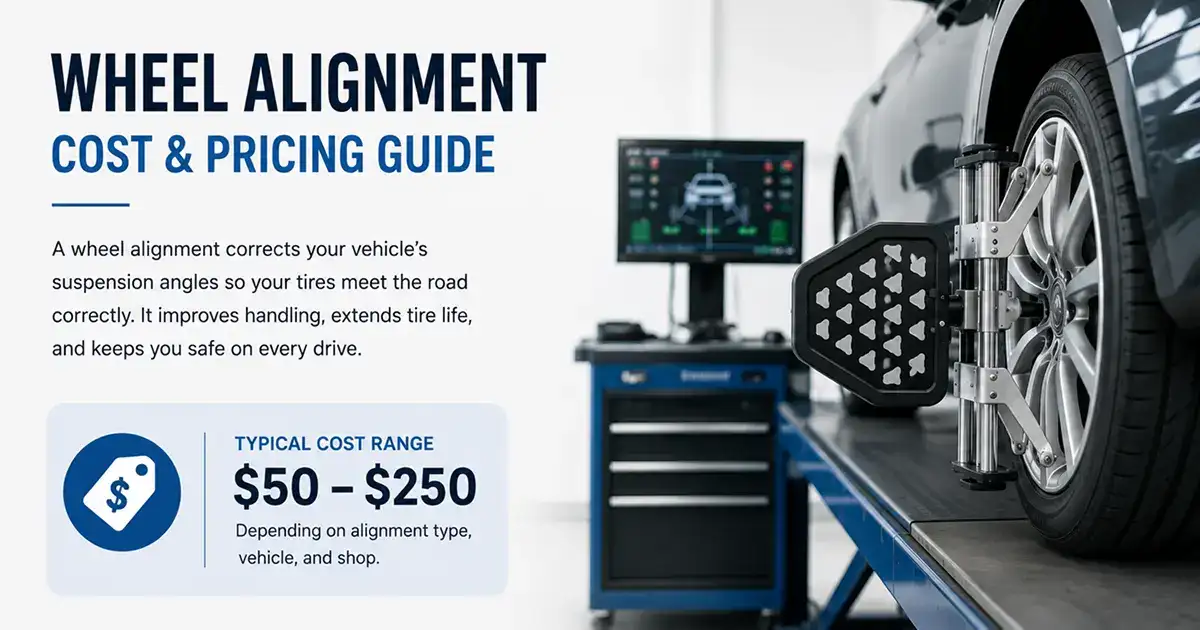
Wheel alignment pricing depends mainly on how many wheels need adjusting and what kind of vehicle you drive. If you’re wondering how much does a wheel alignment cost for your specific make and model, the range below is the best general answer available before a technician inspects your vehicle.
| Alignment Type | Typical Cost Range | Best For |
| Front-end (2-wheel) alignment | $50 – $100 | Older vehicles and trucks with a solid rear axle |
| Four-wheel alignment | $100 – $250 | Most modern cars, SUVs, and trucks with independent rear suspension |
| Lifetime alignment package | $150 – $250+ | Drivers who want unlimited alignments for as long as they own the vehicle |
According to one alignment guide (updated 2022), a standard front-end alignment typically falls in the $65–$100 range, while more involved four-wheel jobs can run higher depending on the vehicle. Your final price will depend on your specific make and model, so the fastest way to get an exact number is to book a free alignment check with a certified service team.
Front-End (2-Wheel) vs. 4-Wheel Alignment Cost
The main reason “wheel alignment price” varies so much online is that not every car gets the same service:
- Front-end alignment adjusts only the two front wheels. It’s faster, cheaper, and typically sufficient for solid-rear-axle vehicles like older trucks.
- 4-wheel alignment adjusts all four wheels and resets the vehicle’s thrust angle, the imaginary line that should run perfectly down the center of the car. Thrust angle tells the alignment technician whether the rear wheels are pointed straight ahead or pulling the whole car off-center. Most modern vehicles, including nearly every current Chevrolet and GMC model, require a 4-wheel alignment because they use independent rear suspension.
If you’re unsure which one your vehicle needs, that’s a normal question, and it’s exactly what a quick inspection at a certified service center will confirm before any work begins.
Why Does a Wheel Alignment Cost That Much?
Alignment pricing isn’t arbitrary. A handful of factors determine where you land in the $50–$250 range:
- Vehicle type and suspension design. Trucks, SUVs, and vehicles with independent rear suspension take more time on the alignment rack than a basic sedan, which raises labor cost.
- How far out of spec the wheels are. A car that’s slightly off from a curb tap adjusts quickly. A vehicle that’s been driven for months with a bent component may need additional diagnostic time, or replacement parts, before the alignment machine can even get it into spec.
- Additional repairs found during inspection. Alignment techs frequently find worn tie rods or ball joints during the process, the steering and suspension components that connect your wheels to the rest of the car. If these are worn, the alignment won’t hold even after it’s adjusted, and replacing them adds to the total cost.
- Equipment used. A shop using a modern, computerized alignment rack with laser-guided sensors can measure caster, camber, and toe more precisely than an eyeball adjustment, and that accuracy is part of what you’re paying for.
- Local labor rates. Alignment cost varies by region and by shop type, with dealership service centers, independent garages, and tire chains all pricing labor differently.
The Three Angles Every Alignment Technician Sets
Every alignment, front or full 4-wheel, comes down to adjusting three angles to your manufacturer’s exact OEM alignment specifications:
- Toe: how much the tires point inward or outward when viewed from above. This is the single biggest driver of uneven tire wear.
- Camber: the inward or outward tilt of the tire when viewed from the front. Excessive camber wears down one edge of the tread faster than the rest.
- Caster: the forward or rearward tilt of the steering axis, which affects straight-line stability and how well the steering wheel returns to center.
Getting all three within factory tolerance is what separates a real alignment from a quick “eyeball” adjustment, and it’s why the equipment and technician training behind the job matter as much as the price tag.
Do I Actually Need a Wheel Alignment?
Not every car needs an alignment on a fixed schedule, but certain signs mean you need one now, regardless of when your last service was.
Signs you need a wheel alignment:
- Your car pulls to one side on a flat, straight road, even with your hands off the wheel.
- Your steering wheel sits crooked when you’re driving straight ahead.
- Uneven or rapid tire wear, especially wear concentrated on one edge of the tread.
- Vibration or wandering in the steering wheel at highway speed.
- You recently hit a pothole, curb, or had suspension work done.
- You just installed new tires: this is the ideal time to check alignment, since it protects your investment from day one.
The National Highway Traffic Safety Administration reports that 511 people died in tire-related crashes in 2024, and notes that routine maintenance, including rotation, balancing, and alignment, helps tires last longer and can improve fuel economy, while neglecting it accelerates uneven wear and shortens tire life. If any of the signs above sound familiar, that’s your answer: yes, you need one.
How Often Should You Get a Wheel Alignment?
Most manufacturers recommend having your alignment checked every 2–3 years or roughly 12,000 miles, whichever comes first. That said, you should move up that timeline any time you:
- Hit a significant pothole or curb
- Have new tires installed or rotated
- Notice any of the warning signs listed above
- Have suspension or steering components repaired or replaced
What Happens If You Don’t Get an Alignment?
Skipping a needed alignment doesn’t make the problem go away. It compounds it, and almost always at a higher cost than the alignment itself would have been.
- Faster, uneven tire wear. Misaligned wheels scrub against the road at the wrong angle, wearing down tread unevenly. A tire that should last 50,000+ miles can be worn out in a fraction of that time.
- Lower fuel economy. Misalignment increases rolling resistance, which means your engine works harder to maintain speed.
- Handling and safety risk. A car that pulls or wanders is harder to control, especially in wet conditions or during an emergency maneuver.
- More expensive repairs down the line. Left long enough, misalignment stresses tie rods, ball joints, and other suspension components, turning a $50–$250 alignment into a much larger repair bill.
In short: a $50–$250 alignment now is almost always cheaper than the tires, fuel, and suspension repairs you’ll pay for later if you skip it.
Misalignment rarely fixes itself, and the longer it goes unchecked, the faster it wears down your tires. If your steering wheel sits off-center, the vehicle drifts to one side on a straight road, or one tire is wearing faster than the others, schedule an alignment check to protect your tires. Catching it early usually means paying for an alignment instead of an alignment plus new tires.
How Much Is a Tire Rotation? (And Should You Do Both Together?)
A standard tire rotation typically costs less than an alignment, often in the $25–$75 range on its own, and it’s frequently bundled with an alignment or included with a service special at many dealerships. Rotation and alignment solve different problems: rotation evens out wear across all four tires, while alignment corrects the angle causing that wear in the first place. If you’re not sure how often that rotation should happen, see our guide on how often to rotate your tires. Getting both services at the same visit is one of the most cost-effective ways to protect your investment when you buy new tires.
Where Can You Get a Wheel Alignment Done in LaGrange, GA?
You generally have three options for alignment service, and each comes with trade-offs:
- Tire chains and quick-lube shops: often the fastest and cheapest option, but equipment quality and technician training vary by location.
- Independent garages: competitive pricing, though parts and diagnostic equipment may not be model-specific.
- Franchise dealerships: use manufacturer-specified equipment and OEM alignment specifications, with technicians trained specifically on your make and model.
For Chevrolet and GMC owners in LaGrange, GA, Auto Gallery Chevrolet GMC’s certified service center uses factory-specified equipment and alignment tolerances built for your exact vehicle, not a generic setting. That matters most on trucks and SUVs with more complex suspension geometry, where getting the thrust angle and toe settings exactly right is the difference between an alignment that lasts and one you’ll be paying for again in six months.
If you’ve noticed any of the warning signs above, or it’s simply been a while since your last check, schedule a wheel alignment appointment with Auto Gallery Chevrolet GMC in LaGrange today, or stop by 1415 Lafayette Pkwy to have it checked while you wait.
Frequently Asked Questions
How much does a wheel alignment cost?
Most drivers pay between $50 and $250 for a wheel alignment. A front-end (2-wheel) alignment typically costs $50–$100, while a full 4-wheel alignment runs $100–$250, depending on your vehicle and where you have it done.
How often should you get a wheel alignment?
Most manufacturers recommend an alignment check every 2–3 years or about 12,000 miles. You should also get one any time you hit a major pothole or curb, install new tires, or notice your car pulling to one side.
What does a wheel alignment do?
A wheel alignment adjusts your car’s suspension angles (toe, camber, and caster) so your tires meet the road at the correct angle. This improves handling, extends tire life, and keeps the vehicle tracking straight instead of pulling or wandering.
What’s the difference between a 2-wheel and 4-wheel alignment?
A 2-wheel (front-end) alignment adjusts only the front wheels and works for vehicles with a solid rear axle. A 4-wheel alignment adjusts all four wheels and corrects the thrust angle, which most modern cars, SUVs, and trucks require due to independent rear suspension.
How much is a tire rotation?
A standard tire rotation typically costs $25–$75 on its own, though it’s often bundled with an alignment or included in a service special. Rotating your tires evens out wear, while an alignment corrects the underlying angle causing that wear.
What are the signs you need a wheel alignment?
Common signs include the car pulling to one side, a crooked steering wheel while driving straight, uneven tire wear, and vibration in the steering wheel at highway speed. Any of these warrants an alignment check.
How long does a wheel alignment take?
A standard alignment usually takes 30–60 minutes on a modern computerized alignment rack, though it can take longer if worn tie rods, ball joints, or other suspension components need to be addressed first.

0 comment(s) so far on How Much Does a Wheel Alignment Cost? Pricing for LaGrange Drivers