





How to Test a Car Battery: Step-by-Step Guide
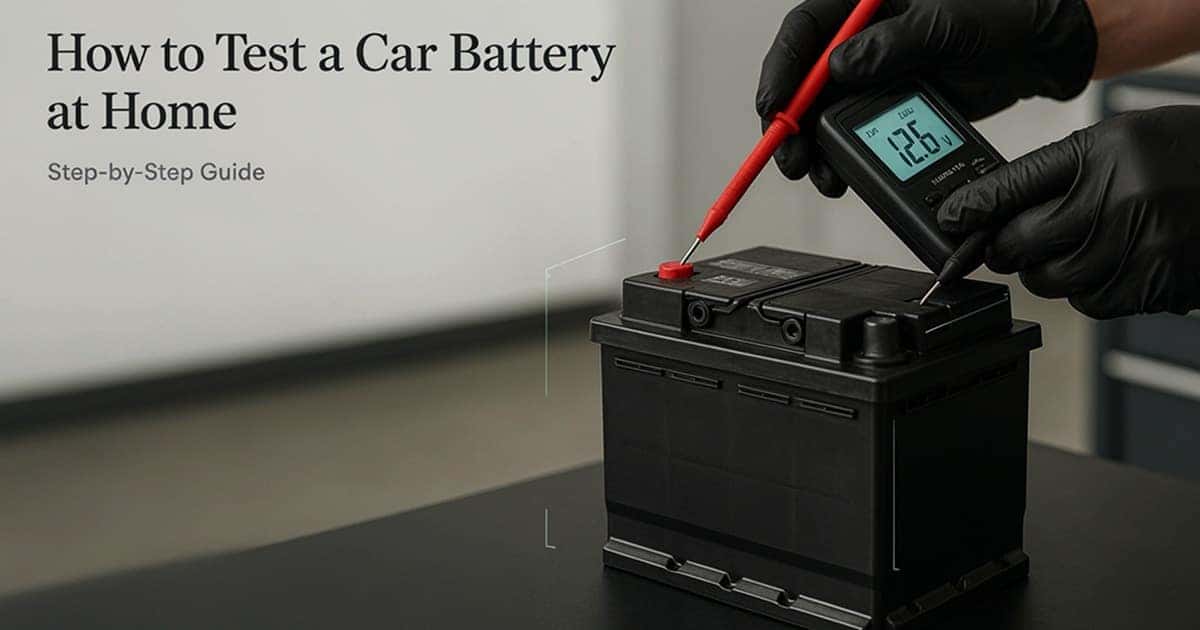
Knowing how to test a car battery starts with a multimeter: it reveals whether your battery is strong, weak, or ready to fail, and you can run the check yourself in about five minutes. Set the multimeter to 20V DC, touch the red probe to the positive terminal and the black probe to the negative terminal, and read the display: 12.6 volts or higher means a healthy, fully charged battery, while anything below 12.4 volts means it’s time to charge or replace it.
That’s the quick answer. The rest of this guide walks through the full process step by step: what tools you need, how to test while the engine is cranking, what the voltage numbers actually mean, the warning signs of a dying battery, how to tell a battery problem from an alternator problem, and when it’s worth having a professional run a full test instead.
Key Takeaways
- Resting voltage: A healthy, fully charged battery reads 12.6V or higher with the engine off. Below 12.4V, the battery needs charging or testing further.
- Cranking voltage: During startup, voltage should not drop below 9.6V–10V. Lower than that signals a weak battery.
- Running voltage: With the engine on, you should see 13.5V–14.5V. This range reflects the alternator charging the battery correctly.
- Warning signs: Slow cranking, dim headlights, a swollen case, or a battery warning light on the dash all point to a failing battery.
- Battery vs. alternator: If the resting voltage is fine but the running voltage stays low, the alternator (not the battery) is usually the problem.
What You Need to Test a Car Battery
You only need a couple of inexpensive tools to test a car battery at home:
- A digital multimeter ($10–$25 at any auto parts or hardware store). Look for one with a DC voltage setting.
- Gloves and eye protection. Battery acid and sparks are real risks, so don’t skip this.
- A clean rag or wire brush to clear off any corrosion around the terminals before testing, since corrosion can throw off your reading.
- A helper (optional) for the cranking test below, since one person needs to hold the multimeter while the other turns the key.
Before you begin, park on level ground, turn off the engine and all accessories (lights, radio, climate control), and let the car sit for at least an hour if it’s been driven recently. This gives you the true resting voltage, the battery’s charge level when it isn’t being drawn on or charged. Testing right after a drive will read artificially high and mask a weak battery.
How to Test a Car Battery With a Multimeter

This is the core car battery test, and it’s the same basic process whether you’re checking a sedan, truck, or SUV.
- Locate the battery terminals. Pop the hood and find the positive (+) terminal, usually marked with a red cover, and the negative (-) terminal, usually black.
- Set the multimeter to 20V DC. Most multimeters aren’t autoranging, so you’ll need to select this manually.
- Connect the probes. Touch the red probe to the positive terminal and the black probe to the negative terminal. Don’t let the probes touch each other or any metal surface.
- Read the voltage. A healthy battery at rest should show 12.6V or higher. If the number appears with a minus sign in front of it, your probes are reversed; the reading is still accurate, just flip them.
- Compare against the voltage chart below to figure out what your reading means.
If your battery reads low, don’t assume the worst right away. A weak reading sometimes just means the battery needs a full charge before you retest. But a battery that keeps dropping back down after charging is very likely failing for good. This is the core of how to test a car battery reliably: one reading tells you a little, but a pattern across a few tests tells you a lot more.
What Voltage Should a Car Battery Have?
Car battery voltage means something different depending on whether the engine is off, cranking, or running. Here’s how to read each stage:
| Condition | Normal Voltage Range | What It Means |
| Resting (engine off) | 12.6V or higher | Fully charged, healthy battery |
| Resting (engine off) | 12.2V – 12.5V | Partially charged; charge and retest |
| Resting (engine off) | Below 12.2V | Weak or failing; may need replacement |
| Cranking (starting) | 9.6V – 10V or higher | Adequate cranking strength |
| Cranking (starting) | Below 9.6V | Weak battery, insufficient cranking power |
| Running (engine on) | 13.5V – 14.5V | Alternator is charging correctly |
| Running (engine on) | Below 13.5V | Possible alternator or charging system issue |
According to a J.D. Power battery testing guide (2024), voltage shouldn’t fall below 10 volts during cranking, and a running reading below 13.5V points to a struggling alternator rather than the battery itself. That distinction matters, since replacing a battery won’t fix an alternator problem, and vice versa.
How to Test a Battery While Starting the Car
A resting voltage test only tells you part of the story. Testing under load, while the engine is actually cranking, shows whether the battery can deliver enough power when it matters most.
- Connect the multimeter the same way as before, red to positive, black to negative, with the engine off.
- Have a helper turn the key to start the car while you watch the multimeter.
- Watch the lowest number the display shows during that first second or two of cranking. This is the true test of your battery’s cold cranking amps (CCA), the industry rating for how much current a battery can deliver at low temperature to start an engine.
- Note whether it stays above 9.6V–10V. If it drops lower, or if the engine cranks slowly with a “rur-rur-rur” sound instead of turning over quickly, the battery is struggling to deliver power under load.
- Once running, recheck the voltage. It should climb to 13.5V–14.5V within a few seconds as the alternator takes over charging duties.
This is essentially a simplified version of the professional load test that auto parts stores and service centers run with dedicated equipment: applying a controlled electrical load to the battery and measuring how well it holds voltage under that stress. A multimeter cranking test gives you a rough version of the same insight for free.
How to Tell if Your Battery Is Bad
Not every battery problem shows up as a number on a multimeter. According to Kelley Blue Book’s guide on dying batteries, watch for these signs of a bad car battery:
- Slow or labored cranking. The engine turns over sluggishly instead of starting right away.
- Dim or flickering headlights, especially when idling or with accessories running.
- A clicking sound with no engine turnover when you turn the key, often a sign the battery can’t deliver enough current to the starter.
- A swollen, bloated, or cracked battery case, which usually means internal damage from heat, age, or overcharging.
- Corrosion buildup on the terminals, a white or bluish crusty residue that can block the electrical connection even if the battery itself is otherwise fine.
- A battery warning light on the dashboard, which can point to either a battery or charging system issue.
- The battery is 3 years or older. Age alone is one of the biggest predictors of failure, especially in hot climates where heat accelerates internal wear.
It’s worth noting that a battery can show a “good” resting voltage and still be failing. A battery that reads 12.6V sitting still can still fail a load test, because voltage measures charge level, not the battery’s actual capacity to deliver power under stress. This is exactly why the cranking test and a professional load test catch problems a simple voltage check can miss.
Battery vs. Alternator: How Can You Tell the Difference?
Battery and alternator problems often look identical from the driver’s seat: slow starts, dim lights, a car that won’t crank. The multimeter is what tells them apart.
- If resting voltage is low (below 12.4V) and running voltage stays low too: the battery itself is likely weak or dying.
- If resting voltage looks normal (12.6V+) but running voltage stays below 13.5V: the alternator isn’t charging the battery properly, even though the battery is fine.
- If the car dies shortly after a jump-start: that’s also a classic alternator symptom, since a healthy alternator should keep the engine running and recharge the battery once it’s started.
One more thing worth checking if your battery keeps dying overnight despite testing fine during the day: a parasitic draw, a small but constant electrical drain from something like an interior light, a faulty relay, or an aftermarket accessory that stays powered even with the car off. A parasitic draw can slowly kill a perfectly healthy battery, which is why a technician may test for one if your battery keeps failing without an obvious cause.
When Should You Have Your Car Battery Professionally Tested?
A multimeter test at home is a great first step, but there are times when it makes sense to have a professional run a full diagnostic instead:
- Your battery is 3 years or older, even if it seems to be working fine. Most batteries last three to five years, and testing catches decline before it strands you.
- You’ve needed a jump-start more than once. A repeat jump usually means the battery (or the charging system) needs a real diagnosis, not just another boost.
- Your multimeter readings are inconsistent or borderline, hovering right around the “weak” threshold without a clear answer.
- You suspect an alternator or charging system issue, since diagnosing that accurately requires more than a basic voltage check.
- Before a long road trip or a seasonal temperature swing, since extreme heat and cold are two of the biggest stressors on battery life, and a marginal battery is far more likely to fail under those conditions.
A professional load test uses purpose-built equipment to apply a real electrical load and measure exactly how the battery holds up, catching weak batteries that a resting voltage check alone would miss.
GMC Battery Testing and Service in LaGrange, GA
If your multimeter test came back weak, borderline, or you’d simply rather have a technician confirm it, Auto Gallery Chevrolet GMC’s certified battery service in LaGrange, GA uses manufacturer-specified load testing equipment built for your exact make and model, not a generic setting. That matters most on modern GMC and Chevrolet trucks and SUVs, which often carry more electrical load (infotainment, towing electronics, driver-assist systems) than older vehicles, and need a battery that’s tested to match.
Our certified service center can test your battery, alternator, and charging system in one visit, and if a replacement is needed, our battery replacement guide walks through what that involves before any work begins.
Schedule a battery test with Auto Gallery Chevrolet GMC today, or stop by 1415 Lafayette Pkwy in LaGrange to have it checked while you wait.
Frequently Asked Questions
How do you test a car battery with a multimeter?
Set the multimeter to 20V DC, touch the red probe to the positive terminal and the black probe to the negative terminal, and read the display. A healthy, fully charged battery should show 12.6V or higher at rest.
What voltage should a car battery have?
A healthy battery reads 12.6V or higher at rest, 9.6V–10V or higher while cranking, and 13.5V–14.5V once the engine is running and the alternator is charging it.
How can you tell if your car battery is bad?
Common signs include slow or labored cranking, dim or flickering headlights, a clicking sound with no engine turnover, a swollen or corroded case, and a dashboard battery warning light. A battery that’s 3 years or older is also more likely to be declining.
Can a car battery have good voltage and still be bad?
Yes. A battery can show a normal resting voltage, like 12.6V, and still fail under load. Voltage measures charge level, not the battery’s true capacity to deliver power, which is why a cranking test or professional load test can catch problems a simple voltage check misses.
How do you know if it’s the battery or alternator?
If resting voltage is low and stays low with the engine running, the battery is likely the problem. If resting voltage looks normal but running voltage stays below 13.5V, the alternator isn’t charging the battery correctly, even though the battery itself may be fine.
When should you have your car battery tested?
Have it tested if it’s 3 years or older, if you’ve needed more than one jump-start, if your at-home readings are inconsistent, or before a long trip or major seasonal temperature swing, since heat and cold are the biggest stressors on battery life.

0 comment(s) so far on How to Test a Car Battery: Step-by-Step Guide